
The 4% Rule in 2026: Does It Still Work?
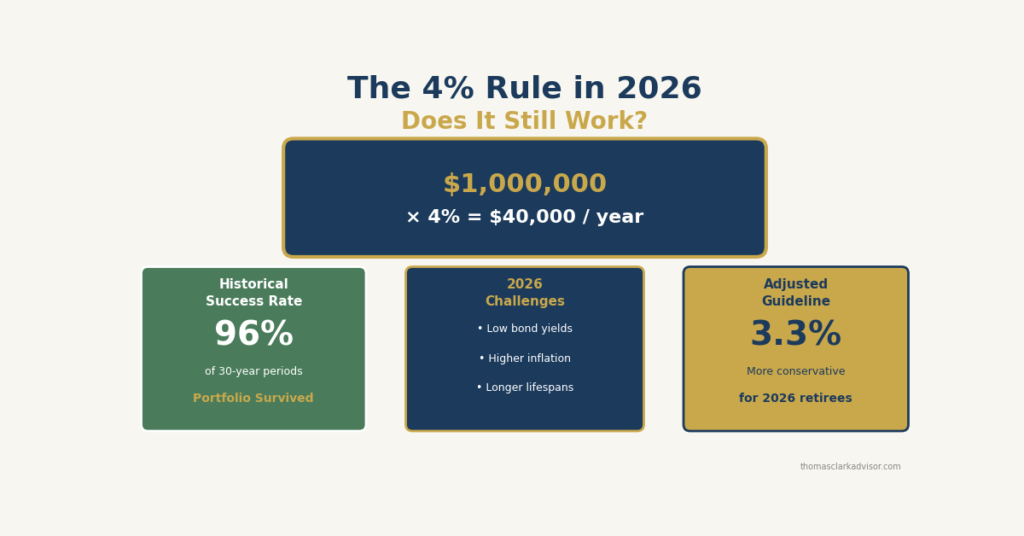
The 4% Rule in 2026: Does It Still Work?
Table of Contents
- Where the 4% Rule Came From
- What the 4% Rule Actually Says — and What People Get Wrong
- What the Updated Research Shows
- Why Today’s Environment Is Different
- The Guardrails Approach: Flexible Spending That Moves with Markets
- The Floor-and-Upside Strategy: Guaranteed Income First, Portfolio Second
- Dynamic Withdrawal Strategies Beyond the 4% Rule
- How Social Security Timing Changes the Entire Equation
- Hypothetical Comparison: Three Approaches on a $1M Portfolio
- The Real Answer: Your Withdrawal Rate Should Be Personal
- Key Takeaways
- Frequently Asked Questions
William Bengen sat down in 1994 and asked a straightforward question: what is the maximum percentage a retiree could safely withdraw from their portfolio each year without running out of money? His answer — roughly 4 percent — became one of the most cited pieces of research in personal finance history. It anchored the retirement planning conversation for three decades.
But here is the problem: that was 30 years ago. Bond yields looked nothing like they do today. Life expectancies were shorter. Market valuations were considerably lower. The average retiree was planning for a 25 to 30-year horizon, not the 35 to 40 years that many couples in their early sixties need to plan for now.
So the question I get from clients more often than almost any other is: does the 4% rule still hold up in 2026?
The honest answer is nuanced, and that is exactly why I wanted to write this guide. The 4% rule is a useful starting point — not a retirement plan. The research that has followed Bengen’s original work suggests that rigid adherence to any single withdrawal rate is a mistake, and that the most durable income strategies are the ones built with flexibility at their core.
Let me walk you through what the original research actually said, what the updated evidence shows, and — more importantly — what a smarter approach might look like for your situation.
Where the 4% Rule Came From
To evaluate whether the 4% rule still works, you first have to understand what it actually was.
In 1994, financial planner William Bengen published a landmark paper in the Journal of Financial Planning that analyzed historical U.S. market data going back to 1926. His methodology was straightforward: he tested what would have happened to a retiree with a 50/50 stock-bond portfolio if they withdrew a fixed percentage of their starting balance in year one, then adjusted that dollar amount for inflation every year after — across every 30-year rolling period in the historical record.
His goal was to find the highest withdrawal rate that would have survived every single 30-year period, including the absolute worst historical sequences — the Great Depression, the stagflation of the 1970s, the market crashes that hit retirees hardest. He called this the SAFEMAX: the maximum safe withdrawal rate across all historical scenarios.
That number came out to approximately 4.15 percent.
Bengen was not saying 4 percent was guaranteed or optimal. He was saying it would have survived every historical worst-case scenario across his testing period. The stock allocation in his model was 100 percent large-cap U.S. equities, balanced against intermediate U.S. government bonds.
Shortly after, the Trinity Study — published in 1998 by three finance professors at Trinity University — expanded on Bengen’s work and confirmed similar findings across different portfolio allocations and time horizons. The phrase “4% rule” entered the mainstream, and an entire generation of retirement planning was built around it.
Thomas’s Take: The 4% rule was never meant to be a prescription — it was a historical observation about what had worked in the past. Bengen himself has updated his views multiple times since 1994, including suggesting that a broader asset allocation might support higher initial withdrawal rates under the right conditions.
What the 4% Rule Actually Says — and What People Get Wrong
Before we assess whether the rule holds up today, I want to address the single most common misconception I encounter in conversations with clients and pre-retirees: the 4% rule does not mean you withdraw 4 percent of your current portfolio balance every year.
That distinction matters enormously.
Here is what the rule actually says:
- Year one: Withdraw 4 percent of your starting portfolio balance. If you have $1,000,000, that is $40,000.
- Every subsequent year: Withdraw the same dollar amount as the prior year, adjusted upward for inflation. Not 4 percent of whatever the portfolio is worth that year — the same dollar amount, inflation-adjusted.
So if inflation runs at 3 percent in year two, you withdraw $41,200. If the portfolio drops to $850,000 during a downturn, you still withdraw that same inflation-adjusted amount. The rule is about maintaining consistent purchasing power, not about recalculating a percentage each year.
Why does this distinction matter? Because withdrawing a fixed percentage of your current balance — say 4 percent each year regardless of portfolio size — is actually a very different (and in some ways more sustainable) strategy. It also means your income fluctuates with the market, which many retirees find difficult to manage in practice.
The second misconception: the 4% rule was designed for a 30-year retirement. It says nothing about what is safe for a 35 or 40-year retirement — which is increasingly the relevant planning horizon for couples retiring in their early sixties today.
Image: Side-by-side infographic showing two scenarios: (1) Rigid 4% rule — fixed dollar withdrawal adjusted for inflation, and (2) the common misconception — 4% of current balance each year. Navy (#1B3A5C) backgrounds with gold (#C9A84C) callout boxes on cream (#F8F6F0) card panels. Alt text: “Infographic comparing the correct 4% rule methodology — fixed dollar amount adjusted for inflation — versus the common misconception of withdrawing 4% of current portfolio balance annually.”
What the Updated Research Shows
The research community has not stood still since 1994. And the most recent findings present a more cautious picture than Bengen’s original SAFEMAX.
The Trinity Study Updates
The Trinity Study has been updated multiple times over the years. Later versions extended the time horizon and incorporated more recent market data. The general conclusion held for 30-year periods with a significant stock allocation — but success rates degraded meaningfully as the time horizon stretched toward 35 and 40 years.
Morningstar’s Recent Research
Morningstar’s retirement research team has published updated guidance suggesting that retirees in 2025 and 2026 should consider a more conservative starting withdrawal rate in the range of 3.3 to 3.7 percent — not 4 percent — particularly for those with 35-year or longer planning horizons.
Their reasoning centers on several factors: current equity valuations are elevated relative to historical averages (implying lower forward returns), the fixed income landscape has improved somewhat from its 2021 lows but remains historically complex, and longer life expectancies mean more years of portfolio withdrawal pressure. Morningstar’s 2024 State of Retirement Income research suggested a 3.7 percent starting rate for a 30-year horizon with a balanced portfolio, dropping to 3.3 percent or lower for longer horizons or more conservative allocations.
What This Means in Practice
A 3.5 percent starting withdrawal rate on a $1,000,000 portfolio means $35,000 in year one rather than $40,000. That $5,000 difference might feel modest, but over a 30-year retirement with inflation adjustments, the gap between a 4% and a 3.5% strategy can compound significantly — both in terms of total withdrawals and portfolio survivability.
Pro Tip: The difference between a 4% and 3.5% starting withdrawal rate is not just $5,000 per year — it is the difference between a plan that might run out at year 28 and one that has a meaningful probability of leaving a legacy. The math of compounding works in both directions.
Why Today’s Environment Is Different
Three structural changes have altered the landscape for retirees compared to the environment Bengen was analyzing.
1. Lower Expected Returns on Bonds Than Historical Averages
Bengen’s original research ran through periods when intermediate Treasury bonds routinely yielded 5, 6, even 7 percent or more. Those yields provided a meaningful safety cushion within the 50/50 portfolio — bond returns helped offset equity downturns and funded withdrawals during bad stock years.
Today’s bond environment, while improved from the near-zero rates of 2020-2021, remains below the historical averages that undergirded the original research. This matters because a key mechanism of the 4% rule was that bonds could carry the portfolio during equity downturns. If bonds generate less real return, the equity side carries more of the burden — and sequence-of-returns risk increases. For a deeper look at how this affects your plan, see my article on sequence-of-returns risk in retirement.
2. Longer Retirements — 35 Years Is Now a Realistic Planning Horizon
A couple retiring at age 62 in 2026 with average health profiles needs to plan for the realistic possibility that one of them lives past 90 or even 95. According to the Society of Actuaries, there is roughly a 50% probability that at least one member of a healthy 65-year-old couple survives past age 90.
Bengen’s SAFEMAX was defined for a 30-year period. Success rates for any given starting withdrawal rate decline meaningfully as you extend the time horizon. A rate that worked for 30 years in historical testing may have a substantially lower probability of success over 40 years — particularly in the current return environment.
3. Higher Market Valuations Imply Lower Forward Returns
Research by John Shiller and others has long documented that starting market valuations — commonly measured by the cyclically adjusted price-to-earnings ratio, or CAPE — have meaningful predictive power over subsequent 10-year returns. When the CAPE is elevated, forward returns have historically been lower. This does not mean markets will crash, but it does suggest that expecting historical average equity returns going forward may be optimistic. A plan built on above-average return assumptions is a fragile plan.
To understand more about how inflation compounds the pressure on retirement portfolios, see my article on inflation risk in retirement.
The Guardrails Approach: Flexible Spending That Moves with Markets
One of the most compelling responses to the limitations of a rigid withdrawal rate is what financial planner Jonathan Guyton and researcher William Klinger developed in a series of papers starting in the mid-2000s: the guardrails approach, also known as the Guyton-Klinger decision rules.
The core insight is elegant: rather than withdrawing a fixed inflation-adjusted dollar amount regardless of what markets do, you build a system of rules that allow spending to flex upward in good years and tighten in bad ones. The result is a strategy that can support a higher initial withdrawal rate than the rigid 4% rule — because you are not locked into paying the same amount when the portfolio is under stress.
Here is how the guardrails framework works in broad terms:
The Withdrawal Rate Rule: You calculate your current withdrawal rate each year (annual withdrawal divided by current portfolio value). If this rate rises above a defined ceiling (say 20% above your initial rate — for example, above 4.8% if you started at 4%), you cut your withdrawal by 10%. This is the lower guardrail.
The Prosperity Rule: If your current withdrawal rate drops below a defined floor (say 20% below your starting rate — for example, below 3.2% if you started at 4%), you give yourself a 10% raise. This is the upper guardrail.
The Inflation Rule: In years when the portfolio performs positively, you adjust your withdrawal upward for inflation. In years when the portfolio declines, you skip the inflation adjustment.
The practical effect is a portfolio that signals to you when to spend more freely and when to tighten your belt — before the damage becomes irreversible. Research by Guyton and Klinger found that this approach could support starting withdrawal rates meaningfully above 4% for 40-year periods, with relatively modest spending cuts required in bad scenarios.
The limitation of the guardrails approach is behavioral: it requires a retiree to actually reduce spending when the guardrails trigger, which can feel alarming in the moment. Having a clear plan in writing — and a fiduciary advisor who helps you stick to it — makes a meaningful difference.
Thomas’s Take: The guardrails approach works precisely because it treats retirement income as a dynamic system, not a fixed entitlement. The spending flexibility is the price you pay for higher initial income. Thomas’s Take: The guardrails approach works precisely because it treats retirement income as a dynamic system, not a fixed entitlement. The spending flexibility is the price you pay for higher initial income. Once that trade-off is named explicitly, most retirees find it reasonable — they’d rather have more income in good years and fewer rigid guarantees than the reverse.
The Floor-and-Upside Strategy: Guaranteed Income First, Portfolio Second
Another powerful alternative to rigid 4% rule thinking is the floor-and-upside approach — sometimes called liability-matching or the income floor strategy.
The concept is straightforward: you begin by identifying your essential expenses in retirement — housing, food, utilities, healthcare premiums, insurance — the non-negotiables. Then you cover those expenses with guaranteed income sources that do not depend on portfolio performance: Social Security, pensions, annuities, or a TIPS ladder. This is your floor.
Once your essential expenses are covered by guaranteed income, your investment portfolio is freed from the pressure of funding necessities. It can be invested more aggressively, managed for growth, and drawn upon for discretionary spending — travel, gifts, hobbies, one-time purchases — without the anxiety of “what if markets are down this year?”
Why This Changes the Withdrawal Rate Math
If Social Security covers $60,000 of your $90,000 annual spending need, your portfolio only needs to fund the remaining $30,000. On a $1,000,000 portfolio, that is a 3% withdrawal rate — comfortably below even the most conservative current research thresholds. And because that $30,000 is discretionary (it funds the enjoyable parts of retirement, not the essential parts), a temporary reduction in bad market years is far easier to absorb.
This is the philosophical framework behind what I have written about in my article on building a retirement income floor. The question is not just what rate you withdraw — it is what you are withdrawing for, and whether any of those needs can be met with guaranteed income instead.
Dynamic Withdrawal Strategies Beyond the 4% Rule
Beyond guardrails and floor-and-upside, several other dynamic approaches have gained traction in the research and among practitioners.
Percentage-of-Portfolio Method
Instead of withdrawing a fixed inflation-adjusted dollar amount, you withdraw a fixed percentage of your current portfolio balance each year — say 4% or 5% of whatever the portfolio is worth on January 1st. Your income fluctuates with markets, but your portfolio is mathematically impossible to exhaust (you can never withdraw 100% of a portfolio that adjusts downward). The drawback is income volatility, which some retirees find unmanageable.
Required Minimum Percentage (RMP)
Developed by researchers as a more structured version of the percentage-of-portfolio method, RMP sets withdrawal percentages based on your remaining life expectancy rather than a fixed rate. As you age, the percentage you withdraw increases because your remaining horizon shortens. This method aligns your withdrawal strategy with actuarial reality.
Vanguard’s Dynamic Spending Framework
Vanguard has published dynamic spending research suggesting a floor-and-ceiling rule: you set a maximum increase (say 5%) and a maximum decrease (say 2.5%) in annual withdrawals, regardless of inflation or portfolio performance. This creates a smoothing mechanism that provides both stability and downside protection. Historical simulations suggest this approach can support meaningful income levels while preserving portfolio health across most scenarios.
For more on how asset allocation intersects with all of these withdrawal strategies, see my article on why retirees need stocks in their portfolio.
How Social Security Timing Changes the Entire Equation
If there is one planning decision that has more leverage over retirement income sustainability than any other, it may be the Social Security claiming age — and it interacts directly with whatever withdrawal strategy you use.
Here is the core mechanism: every year you delay claiming Social Security past your full retirement age (up to age 70), your benefit grows by approximately 8 percent through delayed retirement credits. That is a guaranteed, inflation-adjusted, government-backed 8 percent increase — with no investment risk whatsoever.
What Delaying Does to Portfolio Pressure
If you delay Social Security from age 66 to 70, you might increase your monthly benefit from $2,200 to roughly $3,000 or more. That additional $800 per month — $9,600 per year — is permanent, inflation-adjusted, and guaranteed. It comes directly off the pressure your portfolio faces.
Here is the strategic implication: the years between retirement and age 70 may be the right time to draw more heavily on your portfolio (or use a bridge from taxable accounts), and the years after 70 become dramatically easier on the portfolio because guaranteed income carries a larger share of spending.
This is why the 4% rule question cannot be answered without knowing your Social Security situation. A retiree with $60,000 in guaranteed annual income needs only $30,000 from a $1,000,000 portfolio — a 3% withdrawal rate. A retiree with zero guaranteed income needs all $90,000 from the portfolio — a 9% withdrawal rate that no rule of thumb can sustain.
The most powerful retirement income strategies combine delayed Social Security claiming with a coordinated portfolio withdrawal plan for the bridge years. For more on common mistakes in this area, see my article on retirement withdrawal mistakes and my guide on bucket planning for retirement income.
Pro Tip: Delaying Social Security to 70 is essentially buying inflation-adjusted longevity insurance at a price that is difficult to replicate in the private market. For most healthy retirees, it is the highest-return “investment” available in their entire financial plan.
Hypothetical Comparison: Three Approaches on a $1M Portfolio
To make these strategies concrete, let me walk through a hypothetical comparison of three different approaches for a married couple — call them David and Susan — both age 63, both in good health, with a $1,000,000 investment portfolio. They expect $45,000 per year in combined Social Security at age 67. They need $85,000 per year in total spending. This is a hypothetical example for illustrative purposes only and does not represent any actual client situation.
Approach 1: Rigid 4% Rule
David and Susan retire immediately and begin withdrawing $40,000 per year from their portfolio (4% of $1,000,000), also claiming Social Security at 63 to fill the gap. Their combined Social Security at 63 might be approximately $31,500 per year (permanently reduced by early claiming). Total income: roughly $71,500 — short of their $85,000 target. To meet their spending need, they actually need closer to a 5.35% portfolio withdrawal rate from the start, which significantly reduces long-term sustainability. Even at a strict $40,000 initial withdrawal with inflation adjustments, the historical success rate for a 40-year horizon is meaningfully lower than for 30 years.
Approach 2: Guardrails Strategy
David and Susan establish a 4.5% initial withdrawal rate ($45,000 from the portfolio) with Guyton-Klinger guardrail rules. They delay Social Security to age 67, bridging the gap with portfolio withdrawals during the interim years. When Social Security begins at $45,000 combined, their portfolio need drops to $40,000 per year — and the guardrails system automatically signals if spending should be adjusted. The guardrails give them a higher initial income than the rigid rule, with built-in protection that prevents the portfolio from being overwhelmed in sustained down markets.
Approach 3: Floor-and-Upside
David and Susan identify $55,000 of their $85,000 annual budget as essential expenses. They maximize Social Security by delaying to age 70, bringing combined benefits to approximately $60,000 per year — fully covering essential expenses and then some. Their portfolio now only needs to fund $25,000 per year in discretionary spending, a 2.5% withdrawal rate. In good market years, they take more. In bad years, they scale back discretionary travel and gifts without affecting their financial security. The portfolio grows meaningfully and has a high probability of leaving a legacy or funding future healthcare needs.
The key takeaway from this comparison is not that one approach is universally correct — it is that the decision to claim Social Security early versus late has more impact on long-term income sustainability than the withdrawal rate itself for many retirees.
The Real Answer: Your Withdrawal Rate Should Be Personal
After everything I have covered — the original research, the updated findings, the alternative strategies — here is the conclusion I keep returning to in every client conversation: the right withdrawal rate for your retirement is not 4 percent. It is not 3.5 percent. It is a number specific to your situation, and it should evolve over time.
The variables that actually determine your sustainable withdrawal rate include:
- Your guaranteed income sources — Social Security, pensions, annuities — and when they begin
- Your actual time horizon — planning to age 90 is very different from planning to 95
- Your spending flexibility — how much of your budget is discretionary versus fixed
- Your asset allocation and investment costs — a higher-equity, lower-cost portfolio has historically supported higher withdrawal rates
- Your sequence-of-returns buffer — do you have cash reserves that allow you to avoid selling equities during down markets?
- Your tax situation — coordinating withdrawals across Roth, traditional, and taxable accounts can stretch portfolio life meaningfully (see my article on sequence-of-returns risk)
- Your behavioral tolerance for adjustment — can you genuinely reduce spending when the guardrails signal it?
What the 4% rule gives you is a reasonable starting point for a thought experiment. What it cannot give you is a retirement plan.
The frameworks I find most useful are built around these variables — not around a single number from a paper published when most of us were using dial-up internet. The research has moved. The tools have improved. Your plan should reflect both. The research has moved. The tools have improved. Your plan should reflect both.
Key Takeaways
- The 4% rule originated from William Bengen’s 1994 research showing a 4.15% SAFEMAX for a 50/50 portfolio over 30-year historical worst-case scenarios — it was never a guarantee, and it was built on a different market environment
- The most common misconception is that the rule means withdrawing 4% of current balance each year — it actually means withdrawing 4% of the starting balance in year one, then adjusting that dollar amount for inflation, regardless of portfolio changes
- Updated research from Morningstar and others suggests starting withdrawal rates of 3.3 to 3.7 percent may be more appropriate for today’s environment and longer retirement horizons
- Dynamic strategies — guardrails, floor-and-upside, percentage-of-portfolio — can support higher initial income levels than the rigid rule because they build in the spending flexibility that the historical worst-case scenarios demand
- Social Security timing may have more impact on portfolio sustainability than the withdrawal rate itself — delaying to 70 can shift a significant share of income responsibility to guaranteed sources, dramatically reducing portfolio pressure
Frequently Asked Questions
Is the 4% rule still a good starting point for retirement planning?
The 4% rule remains a useful benchmark for early retirement conversations, but it should not be the final word in your plan. Given current market valuations, longer life expectancies, and the complexity of tax-coordinated withdrawals, most retirees are better served by starting with the 4% rule as a rough anchor and then working with a financial professional to build a more dynamic, personalized strategy. For many people planning 35-year or longer retirements, a starting rate closer to 3.3 to 3.7 percent may provide more confidence, particularly if the plan lacks spending flexibility.
Does the 4% rule account for Social Security income?
No — and this is one of the most important things to understand about the rule. Bengen’s original research modeled a portfolio-only scenario: all retirement income came from the portfolio. If you have significant Social Security income, a pension, or other guaranteed income, your portfolio’s required withdrawal rate may be substantially lower than 4%. The more guaranteed income you have, the more flexibility you have with your portfolio withdrawal rate — which is precisely why Social Security timing decisions and the floor-and-upside approach matter so much.
What should I do if markets drop significantly early in my retirement?
A market decline in the first five to seven years of retirement is the most dangerous scenario for a fixed-withdrawal strategy due to sequence-of-returns risk. The most effective responses include: maintaining a cash or short-term bond reserve equivalent to one to two years of expenses so you do not have to sell equities at depressed prices; reducing discretionary spending temporarily; and having a guardrails system in place so spending reductions are guided by a predetermined plan rather than panic. The worst response is to liquidate equities in a downturn and move to an all-cash or all-bond portfolio, which locks in losses and eliminates the recovery participation your plan depends on.
How often should I revisit my withdrawal rate?
At minimum, annually. Your withdrawal strategy should be reviewed each year for changes in portfolio value, inflation, healthcare costs, tax law, and life circumstances. I also recommend reviewing after any significant market movement (up or down), a major life change, or a change in Social Security or Medicare rules. Retirement income planning is not a one-time exercise — it is an ongoing process.
Ready to Build a Plan Around Your Situation?
The 4% rule is a starting point, not a strategy. If you are within five to ten years of retirement — or already there — the decisions you make about withdrawal rates, Social Security timing, and income sequencing will have more impact on your financial security than almost anything else.
If you’d like to keep going on retirement-income topics like this — bucket planning, Social Security timing, sequence-of-returns risk — sign up for the TCA newsletter at the bottom of this page. New posts arrive weekly.
For more on retirement income, bucket planning, and Social Security claiming, browse the retirement planning archive or sign up for the weekly newsletter at the bottom of any page.
This article is published by Confluence Media Group LLC, an independent publisher of educational financial content. Thomas Clark is a Series 65 Investment Advisor Representative. The information provided is for educational and informational purposes only and is not personalized financial, tax, or legal advice. Past performance does not guarantee future results. All investing involves risk, including potential loss of principal. Consult a qualified professional before making financial decisions.
Confluence Media Group LLC is a separate entity from Confluence Capital Management, the investment advisory practice through which Thomas Clark provides advisory services. Advisory services are not offered through this publishing platform.

Thomas Clark is a Series 65 licensed investment advisor and experienced trader. He specializes in investing, retirement planning, and market analysis, helping individuals build wealth and make informed financial decisions.
